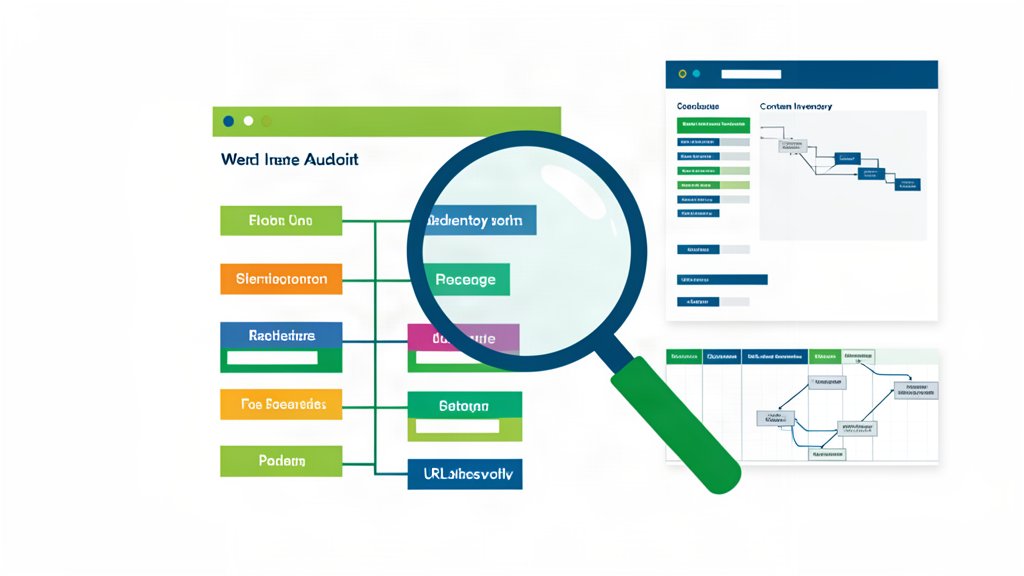
Site restructures usually go wrong when the team reorganizes the navigation before it understands the content.
That creates a familiar outcome: cleaner menus on paper, but more duplication, weaker internal links, and pages that no longer have a clear job. The safer move is to audit the content first and only then decide how categories, directories, and internal links should change.
Google’s current SEO Starter Guide still supports that approach. It emphasizes logical organization, descriptive URLs, grouping topically similar pages in directories, and reducing duplicate content.
Start With Page Purpose, Not Navigation Labels
The first job of an audit is to understand why each page exists.
That usually means classifying pages by role:
- commercial page,
- supporting article,
- archive or taxonomy page,
- policy or utility page,
- outdated or replaceable page.
If the team skips that step, the restructure becomes an argument about labels instead of an argument about purpose.
Check Whether Pages Compete With Each Other
Google’s guidance on duplicate content is useful here.
It does not frame duplicate content as a panic event, but it does make the practical point that multiple URLs with the same information can waste crawl effort and create a confusing user experience. That matters a lot during a restructure.
An audit should identify:
- near-duplicate pages,
- old pages that should redirect,
- thin pages that should be merged,
- archive pages that do not provide distinct value.
This is the difference between a real content audit and a simple URL inventory.
Use Search Intent To Judge Whether A Page Deserves Its Place
Some pages are weak not because they are badly written, but because they do not serve a distinct intent.
Google’s SEO Starter Guide still recommends thinking about the words real users search for and organizing content in a way that helps both users and search engines understand how pages relate. That means each page should answer a real need, not merely occupy a slot in the sitemap.
During the audit, ask:
- what query or question is this page for,
- what job should it do for the visitor,
- what adjacent page already serves that need,
- whether this page deserves a unique URL at all.
That keeps the restructure from preserving weak pages only because they already exist.
Review Directory Logic Before You Rename Everything
Google explicitly notes that grouping similar pages in directories can help search engines understand how parts of a site change over time.
That does not mean every site needs deep nesting. It means the directory structure should make sense.
An audit should check whether the current directories reflect actual topic groupings or whether they are leftovers from old campaigns, old CMS constraints, or old teams.
When directories are changed without that review, restructures often replace one confusing structure with another.
Internal Links Reveal The Real Architecture
Navigation shows the intended structure. Internal links show the actual one.
Google’s guidance on links is still straightforward: links help users and search engines discover pages, and good link text gives more context. That makes internal-link review part of the audit, not a post-launch cleanup task.
Look for:
- important pages with too few internal links,
- clusters of pages that never point to each other,
- outdated links pointing to old or weak pages,
- generic anchor text that hides the topic relationship.
This often exposes the real content hierarchy more clearly than the menu does.
Titles And Snippets Still Matter During A Restructure
Google also points out that clear titles and useful snippets help users decide whether a result is worth clicking.
That means the audit should not stop at structure alone. If two pages are meant to stay separate after the restructure, their titles and descriptions should make that distinction obvious.
Otherwise the site ends up with cleaner folders but still unclear pages.
A Practical Rule
If the restructure plan changes menus, categories, and directories before it decides which pages to keep, merge, redirect, or retire, the order is wrong.
The content decisions should lead. The navigation should follow.
Bottom Line
Audit website content before you restructure the site because page purpose, search intent, duplication, directory logic, and internal linking determine whether the new structure will actually be clearer.
Without that audit, a restructure is often just a prettier version of the same confusion.
References: Google Search Central SEO Starter Guide and Google Search Central on canonicalization and duplicate URLs.
Related areas
Related What I Do
These What I Do pages are matched from the subject matter of this article, creating a cleaner path from educational content to implementation work.
Continue reading
Related articles
Based on shared categories first, then the strongest overlap in tags.