 Goran Štimac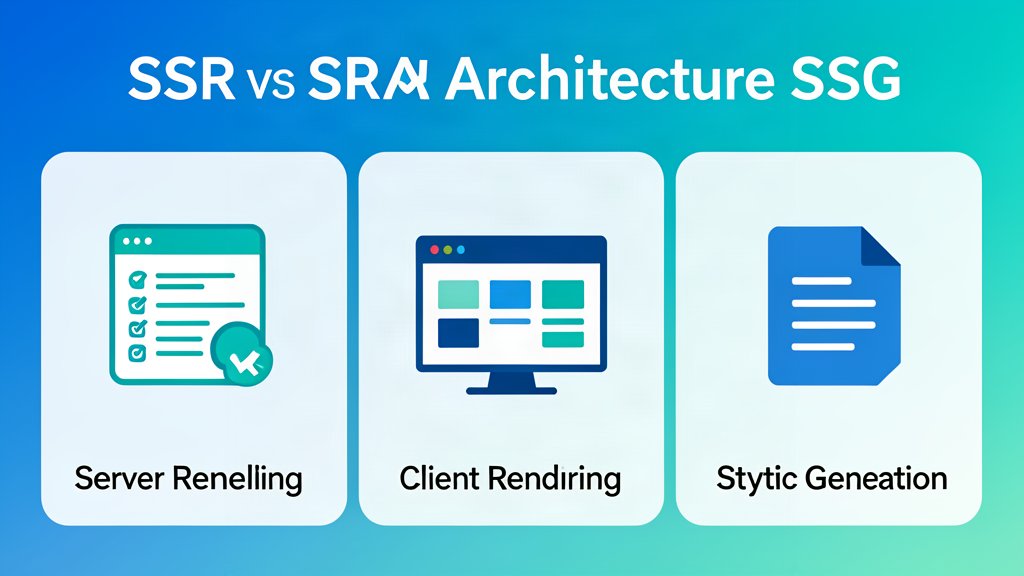
SSR, SPA, and SSG: Comparing Three Rendering Architectures
Choosing between Server-Side Rendering (SSR) and Single-Page Applications (SPA) is one of the most critical architectural decisions when building modern websites. Each approach has distinct trade-offs in SEO, performance, development complexity, and user experience. This guide breaks down everything you need to know to make an informed decision for your project.
Understanding the Core Concepts
What Is a Single-Page Application (SPA)?
A Single-Page Application loads a single HTML page that dynamically updates content via JavaScript without performing full page reloads. The server delivers a static HTML shell and JavaScript bundle, which the browser then parses to fetch and render content after the initial load.
Common frameworks: React, Vue, Angular, Svelte, Create React App (CRA).
What Is Server-Side Rendering (SSR)?
Server-Side Rendering generates complete HTML documents on the server in response to each browser request. The server fetches data from a database and passes it through a template engine to produce ready-to-display HTML before sending it to the browser.
Common frameworks: Next.js, Astro, Remix, SvelteKit, Ruby on Rails, Laravel.
What Is Static Site Generation (SSG)?
Static Site Generation pre-builds pages as static HTML files during a build step and serves them from a CDN. This approach offers the fastest initial load times and is ideal for content that doesn’t change frequently.
Best for: Blogs, marketing sites, documentation.
Rendering Methods Comparison
| Aspect | Client-Side Rendering (CSR/SPA) | Server-Side Rendering (SSR) | Static Site Generation (SSG) |
|---|---|---|---|
| Initial Load | Slow (JS parsing required) | Fast (HTML ready immediately) | Very fast (pre-built HTML) |
| SEO Impact | Poor — requires two-wave indexing | Excellent — full HTML on first request | Excellent — pre-built HTML |
| URL Structure | Hash fragments problematic | Clean, SEO-friendly URLs | Static file paths |
| Crawl Budget | High consumption (two-pass rendering) | Efficient single-pass crawling | Minimal (static files) |
| Dynamic Content | Native support | Full support | Limited (requires ISR) |
| Hosting Cost | Lower (serve static files) | Higher (server-side compute) | Lowest (CDN only) |
| Time to Interactive | 2-5 seconds typical | 0.5-1.5 seconds typical | <0.5 seconds typical |
SEO Implications: The Critical Factor
The SPA SEO Challenge
Search engines historically struggle with JavaScript-heavy applications. When Googlebot crawls an SPA, it undergoes a two-wave rendering process:
- First Wave: Googlebot fetches the raw HTML, which often contains only a minimal shell
- Second Wave: JavaScript rendering is queued and can be delayed by days or weeks
The practical impact: Content may not appear in search results until after the second-wave indexing completes, significantly delaying visibility.
SSR SEO Advantages
| Benefit | Description |
|---|---|
| Improved Crawlability | Search engines can easily index HTML content without JavaScript rendering delays |
| Faster Indexing | Content is available in the first fetch, reducing time to visibility |
| Better Core Web Vitals | Lower First Contentful Paint (FCP) and Largest Contentful Paint (LCP) scores improve ranking potential |
| Social Sharing | Proper meta tags are generated for social platforms (Open Graph, Twitter Cards) |
SPA SEO Mitigation Strategies
If you must use SPA architecture, consider these approaches:
- Server-Side Rendering: Implement SSR via Next.js, Nuxt.js, or a custom Node.js server
- Prerendering Services: Use services like Prerender.io or Netlify Prerendering to generate static HTML snapshots for crawlers
- Subdomain Separation: Deploy the SPA on a subdomain (app.example.com) while keeping marketing pages on the root domain
- Hybrid Approach: Serve static HTML landing pages and place SPA functionality behind authentication
Performance Considerations
Core Web Vitals Impact
| Metric | CSR/SPA | SSR | SSG |
|---|---|---|---|
| First Contentful Paint (FCP) | Slow (2-5s) | Fast (0.5-1.5s) | Very Fast (<0.5s) |
| Largest Contentful Paint (LCP) | Often poor | Generally good | Excellent |
| Time to Interactive (TTI) | 2-5 seconds | 0.5-1.5 seconds | <0.5 seconds |
JavaScript Bundle Size Challenges
SPA Challenge: The entire application is bundled upfront, even for static content that doesn’t require interactivity. This bloats initial download size unnecessarily.
SSR Solution: Modern frameworks like Astro use “Islands Architecture” — shipping zero JavaScript for static content and only hydrating interactive elements when needed. This dramatically reduces bundle sizes while maintaining functionality.
Use Case Recommendations
When to Choose SSR
Ideal For:
- Content-heavy websites (blogs, news portals)
- E-commerce product pages
- Marketing landing pages requiring strong SEO
- Public-facing applications where content discovery matters
- Sites with frequent content updates
Avoid When:
- Budget constraints limit server infrastructure
- The application is purely internal or authenticated
- Real-time interactive features dominate over content consumption
When to Choose SPA
Ideal For:
- Internal dashboards and admin panels
- Logged-in user applications (CRM, project management tools)
- Real-time collaborative tools
- Mobile-first Progressive Web Apps (PWA)
- Applications where SEO is secondary or handled via separate static pages
Avoid When:
- Strong SEO requirements exist for public content
- The website requires content indexing
- First-load performance is critical to user retention
Framework Recommendations by Use Case
| Use Case | Recommended Framework | Reasoning |
|---|---|---|
| Content Marketing / Blog | Astro, Next.js (SSG/SSR) | Fastest initial load, excellent SEO |
| E-commerce | Next.js (SSR + ISR), Nuxt.js | Dynamic content with caching optimization |
| Internal Dashboard | React SPA, Vue SPA | No SEO requirements, simpler architecture |
| Real-time App | Remix, SvelteKit | Optimistic updates, fast reactivity |
| Documentation | Astro, Docusaurus (static) | Static files, minimal overhead |
Advanced Patterns to Consider
Incremental Static Regeneration (ISR)
ISR combines the speed of SSG with the flexibility of SSR. Pages are pre-built as static files but can be regenerated at runtime without requiring a full site rebuild.
Use cases:
- E-commerce sites with changing inventory
- News platforms requiring frequent updates
- Content that needs freshness but benefits from static performance
Streaming SSR
Streaming SSR progressively sends HTML in chunks rather than waiting for complete page generation. This reduces Time to First Byte (TTFB), allowing users to see initial content faster while the rest of the page loads in the background.
Frameworks supporting streaming: Next.js, Remix, Nuxt 3, SvelteKit.
Progressive Hydration
Progressive hydration prioritizes critical content hydration and defers JavaScript activation for non-essential elements. For example, a product title might hydrate first while carousels and filters load afterward, improving perceived performance.
Implementation Checklist
Core SEO Requirements (Any Architecture)
- Unique title tag and meta description per route
- Canonical URL tag pointing to the definitive version
- Structured data (JSON-LD) for content type
- XML sitemap submitted to Search Console
- Clean, descriptive URL structure (no hash fragments for public pages)
SSR-Specific Considerations
- Server environment configuration
- Database connection pooling
- Caching strategy (Redis, CDN edge caching)
- Error handling and fallback content
- Metadata generation per route
SPA-Specific Mitigations
- Enable GA4 Browser history events
- Submit sitemap to Google Search Console
- Add canonical tags to prevent duplicate URLs
- Run URL Inspection on top routes in Search Console
- Consider prerendering service for initial crawl
Monitoring & Measurement
Key Metrics to Track
- Search Console: Index coverage, crawl errors, rich results
- Core Web Vitals: FCP, LCP, TTI across devices
- Server Performance: Time to First Byte (TTFB), request latency
- Business Metrics: Organic traffic, conversion rates by page type
Testing Tools
- Chrome DevTools (disable JavaScript to see first-wave HTML)
- Google Search Console URL Inspection
- Lighthouse auditing
- WebPageTest for geographic performance variations
The Decision Matrix
| Priority | Choose This Approach |
|---|---|
| SEO & Content Discovery | SSR or SSG (Astro, Next.js) |
| Internal Tools / Authenticated Apps | SPA (React, Vue) |
| Hybrid Requirements | BFF pattern: Static marketing pages + SSR app backend |
Conclusion
The choice between SSR and SPA depends on your project’s primary goals. If SEO and content discovery are priorities, SSR or SSG-based architectures provide superior long-term value in terms of search visibility, performance, and user experience. Modern frameworks like Astro and Next.js offer the best of both worlds — delivering SSR/SSG for SEO-critical content while maintaining SPA-like interactivity through progressive hydration.
For most new projects requiring public-facing content, an SSR-based architecture is the recommended starting point. It future-proofs your site against search engine algorithm updates, provides faster initial load times, and delivers a better user experience from the very first interaction.
References:
- Crystallize Blog: “Web Rendering Explained: SSR, CSR & SSG” — Comprehensive comparison of rendering patterns and use cases
- Stackmatix: “Single-Page Application SEO: Complete Guide to Ranking SPAs” — Technical SEO strategies for SPA optimization
- Gracker.ai SEO 101: “Server-Side Rendering Optimization for SPAs” — SSR implementation guide with framework examples
Related areas
Related What I Do
These What I Do pages are matched from the subject matter of this article, creating a cleaner path from educational content to implementation work.
Continue reading
Related articles
Based on shared categories first, then the strongest overlap in tags.