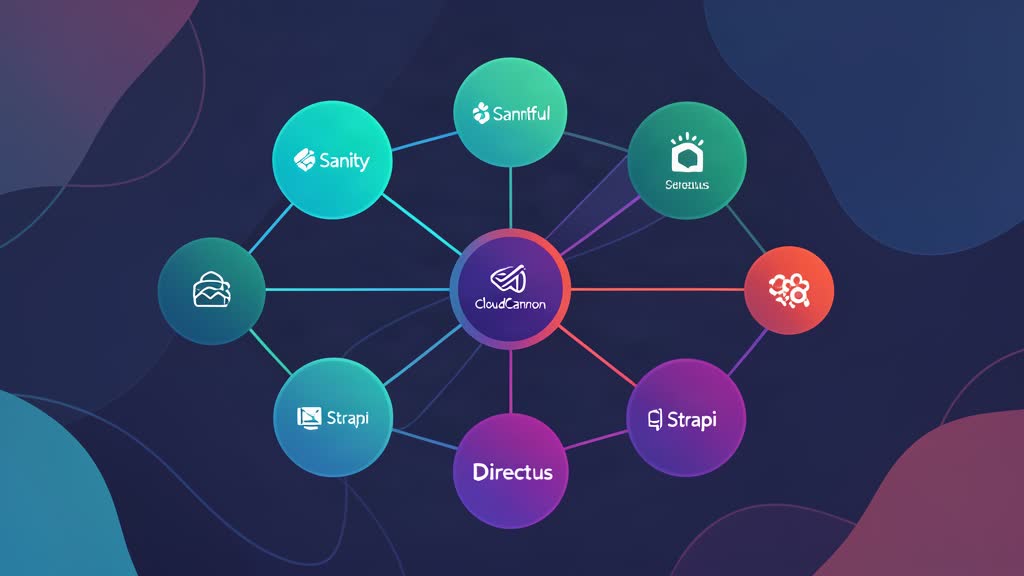
Selecting a headless CMS in 2026 is harder than it was five years ago, not easier. The market has matured, but every platform has drifted into a different architectural niche: Sanity builds for structured real-time collaboration, Contentful for enterprise content supply chains, CloudCannon for Git-centric static workflows, Strapi for self-hosted flexibility, and Directus for wrapping existing SQL databases into an API layer. None is the universal best choice, and the wrong one costs months of migration time and content-team frustration.
This guide compares the five platforms across the criteria that matter most for a production decision: pricing at scale, content modeling flexibility, multilingual support quality, developer experience, and migration path realism. A scoring framework at the end maps your team’s constraints to the right platform.
Pricing at Scale
List pricing is misleading — the real cost reveals itself only when you model your specific content volume, API call count, and user seat needs.
Sanity charges per project dataset, not per API call. The Growth tier ($79/month for 3 projects, 500 K API CDN requests, 100 GB bandwidth) is generous for small teams. At scale, the cost driver is projected growth. Sanity’s real-time synchronization across all connected clients means every content change triggers a write to every open session. A team of 20 editors auto-saving drafts simultaneously generates significantly more bandwidth than 20 scheduled publishers. A typical mid-market deployment with 10 editors, 3 locales, and 50 K documents lands around $400–800/month on the Growth tier.
Contentful is the most expensive platform in this comparison and the most aggressive with metered billing. The free tier is useful for prototypes (2 users, 500 K API calls/month, 3 locales). The Team tier at $489/month for 5 users adds 25 K API calls per second peak and 10 locales. Every additional user ($95/month each) and every locale beyond the tier cap adds to the baseline. At 20 users, 5 locales, and moderate API traffic, Contentful regularly runs $1,500–3,000/month — before add-ons like the Launch web app preview ($249/month) or the AI tagging service.
CloudCannon uses a project-based pricing model starting at $39/month per site (5 users, 10 GB storage, 50 GB bandwidth). For a single site with a small editorial team, it is the cheapest option. The cost grows linearly with sites, not content volume — you pay per site, not per document. A multi-site architecture (documentation site, marketing site, blog) on CloudCannon costs $99–159/month total, far below the equivalent Contentful plan.
Strapi is free and self-hosted (MIT license). Your costs are hosting (a $10–50/month VPS handles most mid-market deployments), database management, backups, and maintenance time. The Cloud plan starts at $29/month for 2 users, 50 K API calls, and 1 GB storage. At 20 users and 500 K API calls, the Team plan runs $249/month. For organisations with existing DevOps capacity, self-hosted Strapi is the lowest recurring cost option by a wide margin.
Directus is free and self-hosted (GPLv3). The Cloud plan starts at $49/month for 1 project, 5 K API calls/hour, and 1 GB file storage. The Team plan at $249/month supports 5 projects, 25 K API calls/hour, and 50 GB file storage. The self-hosted cost is identical to Strapi — hosting infrastructure plus maintenance — but Directus requires a SQL database (PostgreSQL or MySQL) as its data store, which you are likely already running.
Content Modeling Flexibility
Content modeling flexibility determines how much upfront architectural work you need before your editors can start writing.
Sanity uses GROQ queries and a schema-as-code approach where content types are defined in JavaScript or TypeScript. The schema is deployed with the studio frontend, not configured through a UI, which means developers own the content model and editors see only the final Studio interface. This gives Sanity the most programmatic control — you can define custom input components, validation logic, and cross-document references in code — but it requires developer intervention for every schema change.
Contentful offers a UI-first content model builder with 15 field types, validations, and reference fields. Developers can also define the model via the Content Management API or Terraform provider for infrastructure-as-code workflows. The UI is the weakest when migrating complex models: adding a new field type to an existing content type triggers a content migration script that must be written and tested separately.
CloudCannon treats Git as the source of truth for content models. Content types are defined in YAML or JSON files in the repository, and editors interact through CloudCannon’s visual editor on top of the Git-backed files. This is the most transparent model — every content change is a Git commit — but it imposes a file-based content structure that struggles with deeply nested relational models. A three-level hierarchy (project → section → page → component) is manageable. A content graph with ten interconnected content types is not.
Strapi provides a UI-based content type builder that generates the database schema and API endpoints on the fly. It supports relational fields (one-to-one, one-to-many, many-to-many), dynamic zones (freeform component arrays within a content type), and media fields with built-in upload handling. The flexibility cost is the code-first extensibility ceiling: custom queries, non-REST endpoints, and advanced validation require plugin development or direct Knex query injection.
Directus takes a counter-intuitive approach — it introspects your existing SQL database schema and generates the API and admin panel from the database structure. You design the content model in SQL (or use the built-in schema editor), and Directus wraps it in a REST/GraphQL API with built-in permissions, field validation, and relational handling. This is the strongest option for teams that already have a normalized database design and want to expose it as a content API without building a CMS layer on top.
Multilingual Support
For a multilingual site with more than two locales, the CMS’s i18n model determines editorial workflow efficiency more than any other feature.
Sanity supports field-level translations through its document structure. Each language variant lives in the same document as a localized field set. The translation workflow integrates with built-in order management via the Sanity Translation API paired with a service like Smartling or DeepL. The practical limitation is that published vs draft state is per-document, not per-locale — a French editor reviewing an updated English draft cannot publish the French version independently of the English publication date.
Contentful manages translations at the entry level with a dedicated sidebar panel showing the translation progress of each locale. The Contentful Translation Service integrates with 17 third-party providers and supports automatic machine-translation pre-fill for draft locales. Entry-level locale control means each language publishes independently — the German team publishes when their translation is ready without waiting for the Japanese team.
CloudCannon handles translations through file-based locale variants. Each locale is a copy of the content file (e.g., index.md for English, index.fr.md for French). This is the simplest model to reason about — each locale is an independent file — but it creates a synchronization problem: when the English source file adds a new section, every locale file must be updated manually or through a CI-based translation pipeline that diffs the source file and creates translation tickets for the new content.
Strapi offers locale-based content management where each content type is created once and then localized field by field. The i18n plugin creates a separate entry per locale under the same content type, connected by a shared locale-group ID. The weakness is that the admin panel shows all locales in the same list view, making it easy to accidentally edit the wrong locale variant without noticing until publish.
Directus provides field-level translations through its built-in translation interface. Each translatable field has a language switcher in the admin panel, and translations are stored in a separate translation table in the database (normalized, not embedded). This gives Directus the cleanest database-level separation between source and translated content. The limitation is that the multi-locale admin experience is functional but visually cluttered — the language switcher appears per field, not per content type, slowing editorial work on document-heavy workflows.
Developer Experience
Developer experience covers the API quality, local development workflow, preview environments, TypeScript support, and deployment flexibility that determine how fast your team can ship.
Sanity leads on local development: the Sanity Studio runs as a React app you embed in your own frontend or run standalone. The GROQ query language is powerful but proprietary — every developer on the team must learn GROQ syntax to write efficient content queries. The @sanity/client npm package provides excellent TypeScript types and automatic revalidation. Sanity’s Content Lake replication means read latency is near-zero regardless of your deployment region.
Contentful provides a standard REST and GraphQL API with an SDK in every major language. The developer experience is competent but not innovative — the Content Preview API works, the CLI is adequate, and the GraphQL endpoint supports content modeling that mirrors your content types one-to-one. The pain point emerges during local development: the Contentful management API runs only against production or defined environments, and preview environments are a separate paid add-on.
CloudCannon treats the developer workflow as a Git push → preview → publish pipeline. The CMS automatically builds and deploys preview sites from branches or feature branches for Git-based SSGs like Astro, Hugo, and Jekyll. The developer experience is strongest for static-site workflows and weakest for applications that need on-demand server rendering. If your frontend is a Next.js app router site with ISR or an Astro site with hybrid rendering, CloudCannon works seamlessly. If you are building a React SPA that fetches content client-side, most of CloudCannon’s Git-centric automation adds little value.
Strapi provides a REST and GraphQL API generated from the content model. The developer experience has improved significantly in Strapi 5 — TypeScript support is first-class, the API response structure is predictable, and the plugin system allows deep customisation. The main friction point is the release cycle: Strapi 5 is stable in 2026 but breaking changes between major versions mean migration planning is part of any long-term Strapi adoption.
Directus exposes your SQL database schema as a self-documenting REST and GraphQL API with OpenAPI/Swagger auto-generated. The developer experience is the best in this comparison for teams that already think in SQL — you design the schema in your existing migration tooling, and Directus serves it as a content API with zero additional abstraction. For teams that prefer code-first schema design, the TypeScript SDK and SDK-based asset transformations make Directus feel closer to a framework than a CMS.
Migration Path Realism
The cost of migrating out of a headless CMS is the cost you pay once, usually in the first year, and the comparison rarely discusses it honestly.
Sanity has a documented import/export CLI (sanity dataset export and sanity dataset import). The export produces newline-delimited JSON (NDJSON) with the full document tree. Migration out of Sanity requires mapping Sanity’s document schemas and GROQ-filtered export sets to the target CMS’s content model, which is a manual mapping exercise but structurally straightforward because the export is complete.
Contentful makes export trivial (contentful-export) and import into another Contentful space equally easy. Migration out of Contentful to another platform is harder because Contentful’s content model includes environment-specific metadata and locale-group associations that have no equivalent in other systems. Expect to allocate 2–4 developer-weeks for a migration from Contentful to a comparable platform for a mid-size content model of 15–25 content types.
CloudCannon stores everything as flat files in a Git repository. Migration out of CloudCannon is as simple as cloning the Git repo, because there is no separate CMS database. The content is already in the file format your site builds from. This is the strongest migration posture in the comparison — zero lock-in beyond the initial choice to use CloudCannon’s visual editing layer.
Strapi provides a documented data export flow through the Content API (fetch all entries of each content type) and the Files Store for media. Migration out of Strapi requires mapping the content-type relationships manually because Strapi stores them as database foreign keys that the export may flatten inconsistently. The self-hosted nature of Strapi means you have full access to the underlying database, which simplifies bulk export but requires SQL expertise.
Directus stores all content in your existing SQL database with a predictable schema. Migration out of Directus means dropping the Directus-specific system tables and keeping your application tables, which already contain your content in normalized form. This is the second-strongest migration posture — you never lose access to your data in its native format.
Decision Framework
Score each platform against your team’s binding constraint on a 1–5 scale (5 = best fit).
| Criterion | Sanity | Contentful | CloudCannon | Strapi | Directus |
|---|---|---|---|---|---|
| Pricing at scale | 4 | 2 | 4 | 5 | 4 |
| Content modeling flexibility | 4 | 4 | 3 | 4 | 5 |
| Multilingual support | 3 | 5 | 2 | 3 | 3 |
| Developer experience | 5 | 3 | 4 | 4 | 4 |
| Migration path (exit cost) | 3 | 2 | 5 | 3 | 5 |
Choose Sanity if your team wants the best local development workflow and is comfortable embedding a custom React Studio. Best for developer-led content operations with structured, high-volatility content.
Choose Contentful if your organisation needs enterprise-grade multilingual publishing with per-locale independent workflows and has the budget for it. Best for global marketing teams at companies that treat CMS cost as a scaling input, not a constraint.
Choose CloudCannon if your content is purely static, your workflow is built around Git, and you want the cheapest exit cost in the comparison. Best for Astro, Hugo, Eleventy, or Jekyll sites with editorial teams that do not need complex relational content models.
Choose Strapi if you want the maximum self-hosted flexibility with a UI-based content type builder and the lowest upfront cost. Best for teams with DevOps capacity who need a full-featured API without a per-seat subscription.
Choose Directus if you already have a normalized SQL database and want to expose it as a content API without building a CMS layer. Best for teams whose content model is already designed in the database and who want introspection-driven API generation with zero vendor lock-in.
Conclusion
There is no universal best headless CMS in 2026. The right platform is the one whose architectural constraints match your team’s — not the one with the most features, the best UI, or the lowest entry price. Sanity wins on developer velocity. Contentful wins on enterprise multilingual publishing. CloudCannon wins on Git simplicity and exit cost. Strapi wins on self-hosted flexibility. Directus wins on database-first content architecture.
Start with the scoring table above, rate each platform against your team’s binding constraint (pricing ceiling, multilingual requirements, or migration aversion), and eliminate the bottom two before running a technical proof of concept.
Related areas
Related What I Do
These What I Do pages are matched from the subject matter of this article, creating a cleaner path from educational content to implementation work.
Continue reading
Related articles
Based on shared categories first, then the strongest overlap in tags.