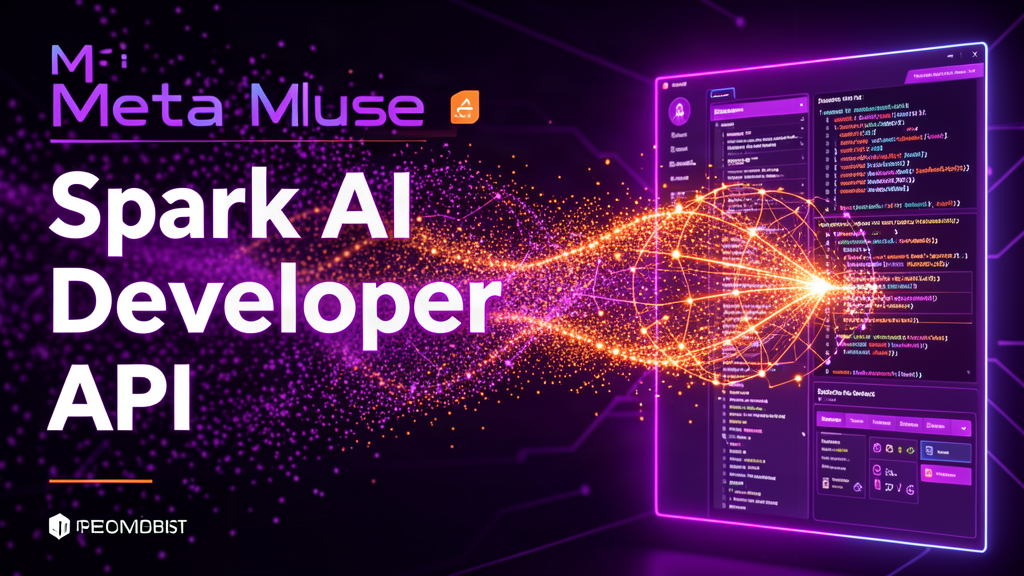
Meta launched its first paid AI model API on July 9, 2026, with the public preview of Muse Spark 1.1. The move marks Meta’s entry into the competitive developer API market dominated by OpenAI and Anthropic — and the company is not holding back on specifications.
Muse Spark 1.1: What Ships
Muse Spark 1.1 is a multimodal reasoning model built explicitly for agentic tasks. It processes text, images, video, and PDFs natively — no separate vision pipeline needed. The 1-million-token context window uses intelligent compaction to prioritize relevant information rather than blindly extending context length.
The model supports multi-agent orchestration natively: a main agent can delegate subtasks to subagents, each operating in their own context. This mirrors the architectural pattern that GPT-5.6’s ultra mode introduced, and suggests the industry is converging on multi-agent delegation as a standard capability.
Computer-use in Muse Spark 1.1 is adaptive — the model decides whether to write a script (for repetitive, batchable operations) or click through a UI (for tasks requiring visual understanding and on-the-fly adaptation). This flexibility makes it particularly suited for cross-application workflows.
Benchmark and Safety
Meta reports major gains in tool use, computer use, coding, and multimodal understanding compared to the original Muse Spark. Internal coding benchmarks show competitive results against leading alternatives. The evaluation report highlights strong resistance to jailbreaks, prompt injection, and developer-prompt attacks — a meaningful improvement for production deployments where prompt security matters.
The Meta Model API
The Meta Model API is OpenAI-compatible, meaning developers can switch endpoints without rewriting integration code. This is a pragmatic choice that lowers the switching cost for teams evaluating Muse Spark 1.1 alongside GPT-5.6 and Sonnet 5.
Replit CEO Amjad Masad described Muse Spark 1.1 as “a complete agentic foundation.” Cline creator Saoud Rizwan and Box also provided endorsements — suggesting the model performs well in real-world coding and enterprise content management scenarios.
What This Means for the AI API Market
Meta’s entry adds a third major competitor to the paid model API market, each with distinct strengths: OpenAI with the broadest tiered family, Anthropic with safety-focused agentic capabilities, and Meta with native multimodal support and the largest context window.
For developers, this means more choice, competitive pricing pressure, and less vendor lock-in. The OpenAI-compatible API lowers the integration cost, while Meta’s research-scale investment in open-weight models (Llama series) gives it credibility with the open-source community that neither OpenAI nor Anthropic fully matches.
Related areas
Related What I Do
These What I Do pages are matched from the subject matter of this article, creating a cleaner path from educational content to implementation work.
Continue reading
Related articles
Based on shared categories first, then the strongest overlap in tags.