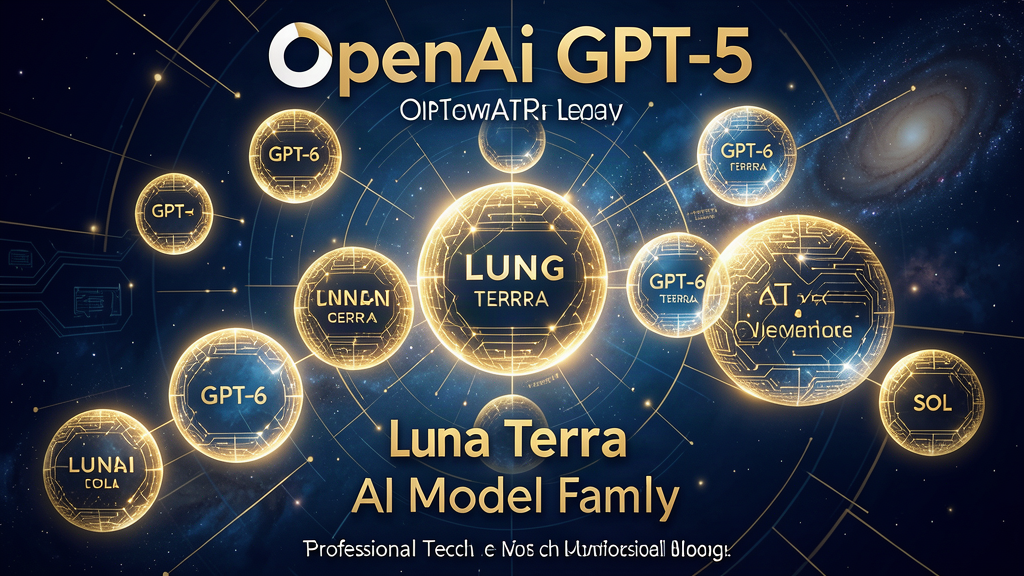
OpenAI released the GPT-5.6 model family on July 9, 2026, marking a strategic shift from single-model releases to a tiered architecture that serves different budgets and workloads. The family — Sol, Terra, and Luna — shares a 1-million-token context window but targets distinct segments of the AI market.
The Three-Tier Strategy
Sol is the flagship model. In its max reasoning configuration, it scores 53.6% on Agents’ Last Exam — 13.1 points ahead of Anthropic Claude Fable 5 (adaptive). On the Artificial Analysis Coding Index, Sol max reaches 80, outpacing Fable 5 by 2.8 points while consuming fewer than half the output tokens, less than half the wall time, and roughly a third of the cost.
Terra sits in the middle — balanced performance at roughly 1/16 the cost of Fable 5. It is designed for teams that need reliable agentic capabilities without paying flagship premiums.
Luna is the most cost-efficient entry point, also outperforming Fable 5 at approximately 1/16 the price. For high-volume tasks like classification, extraction, and customer-facing chat, Luna makes state-of-the-art intelligence viable at scale.
Ultra Mode: Native Multi-Agent Orchestration
The headline feature is the new ultra reasoning mode. In ultra mode, GPT-5.6 coordinates four or more agent instances in parallel by default, each tackling a different facet of a complex task. This is not a prompt hack — it is built into the model’s architecture through OpenAI’s Responses API (now in beta).
Ultra mode is designed for precisely the kind of multi-step workflows that previously required manual agent orchestration: simultaneous research, code generation, testing, and documentation across multiple files and services. For complex command-line tasks, OpenAI’s Terminal-Bench 2.1 and DeepSWE benchmarks show new state-of-the-art results.
Programmatic Tool Calling
Model-level tool orchestration gets a significant upgrade with Programmatic Tool Calling. The model can now write and execute lightweight programs that coordinate tools, filter intermediate data, and decide when to call external APIs — all without requiring a separate agent framework. This reduces the scaffolding teams need to build around the model for production use.
Market Impact
OpenAI MRCR v2 benchmark confirms Sol achieves 91.5% on 8-needle retrieval across 256K–512K context windows — a strong indicator of reliability for enterprise retrieval-augmented generation workloads.
Real-world adopters including Cursor, Notion, Cognition, Ramp, Shopify, Cisco, and Clio have already integrated the GPT-5.6 family. Cursor reported significant improvements in code generation accuracy. Notion highlighted faster and more context-aware AI search. The breadth of adoption — from productivity to enterprise security — suggests this tiered approach matches actual market demand.
What This Means for Developers
The tiered pricing model changes how teams budget for AI. Instead of paying flagship rates for every task, teams can route simpler queries to Luna, balanced workloads to Terra, and complex multi-agent reasoning to Sol. The shared 1M-token context window means no compromise on retrieval or context quality — only on the reasoning depth and cost per token.
The one-model-fits-all era is over. For teams building agentic systems, the GPT-5.6 family offers a practical path from prototype to production at predictable costs.
Related areas
Related What I Do
These What I Do pages are matched from the subject matter of this article, creating a cleaner path from educational content to implementation work.
Continue reading
Related articles
Based on shared categories first, then the strongest overlap in tags.