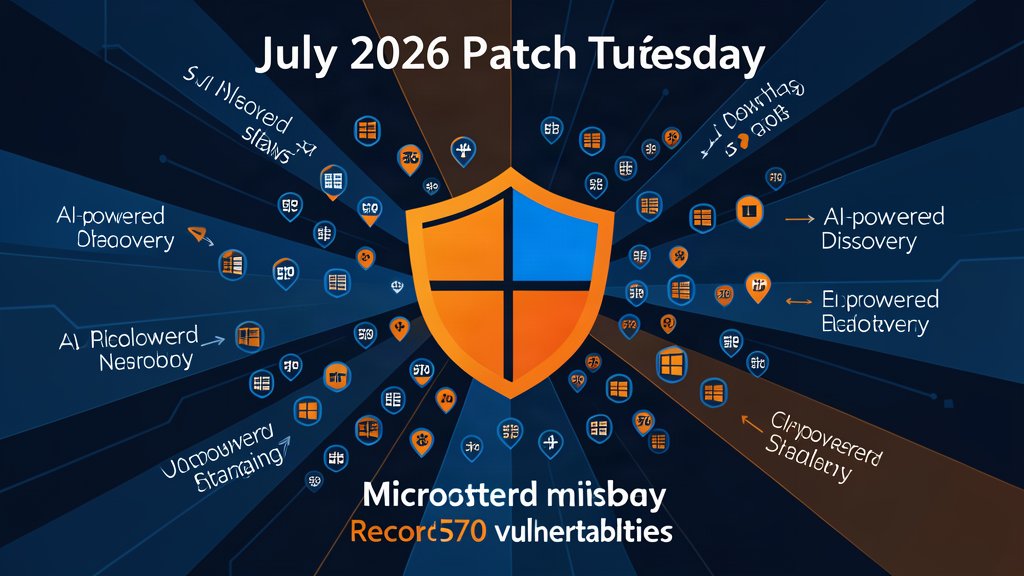
Microsoft released its July 2026 Patch Tuesday updates on July 14, addressing a staggering 570 security flaws — nearly triple the previous record of roughly 200 set the month before. Among them are three zero-day vulnerabilities, two of which are already being actively exploited in the wild.
This is not a one-off spike. Microsoft is flagging this volume as the new baseline for enterprise patch management.
The Numbers Behind the Record
The July 2026 Patch Tuesday fixed vulnerabilities across the entire Windows ecosystem:
- Total flaws patched: 570
- Critical severity: 59
- Remote code execution (Critical): 48
- Zero-days addressed: 3
- Elevation of privilege: 254
- Remote code execution: 145
- Information disclosure: 102
- Denial of service: 35
- Security feature bypass: 17
- Spoofing: 16
The previous record was roughly 200 flaws in June 2026. July nearly tripled that figure.
The Three Zero-Days
CVE-2026-56155 — Active Directory Federation Services EoP (Actively Exploited)
An elevation of privilege vulnerability in Active Directory Federation Services (AD FS) that allows an authenticated attacker to gain administrative privileges. Microsoft’s Detection and Response Team (DART) uncovered the flaw during incident response investigations, indicating it was already being used in active attacks.
CVE-2026-56164 — Microsoft SharePoint Server EoP (Actively Exploited)
A remote elevation of privilege vulnerability in Microsoft SharePoint Server that allows an unauthorized attacker to gain elevated privileges over the network. CISA added this bug to its Known Exploited Vulnerabilities catalog on July 1. Enabling the Antimalware Scan Interface (AMSI) and Full Request Body Scan mode can help mitigate exploitation.
CVE-2026-50661 — Windows BitLocker Security Feature Bypass (Publicly Disclosed)
A publicly disclosed vulnerability that allows attackers with physical access to bypass BitLocker Device Encryption and access encrypted data. Microsoft has not observed active exploitation yet, but public disclosure means the window for attackers to weaponize it is open.
Why the Jump? AI-Powered Discovery
The unprecedented patch volume is a direct result of Microsoft deploying AI-driven static and dynamic analysis tools across the Windows codebase. On July 9, Windows and Devices EVP Pavan Davuluri published a blog post warning customers to expect higher volumes of security updates going forward:
“The pace of vulnerability discovery is changing with advances in AI making it possible to find more issues, faster, across more code, with new mechanisms that can accelerate both discovery and analysis.”
AI models are now systematically combing through billions of lines of Windows code — some of it decades old — uncovering dormant bugs that traditional manual review and fuzzing missed. These are not new vulnerabilities being introduced; they are existing weaknesses that AI can now surface at machine speed.
What This Means for IT and Security Teams
The shift from human-led to AI-augmented vulnerability discovery has immediate practical consequences:
- Expect 400 to 600 patches per month. This is not a one-off record. Microsoft’s AI pipeline will continue finding dormant bugs at this rate for the foreseeable future.
- Update your patch management SLAs. If your organisation has a 30-day patch cycle, the volume increase alone may push you past internal deadlines. Prioritise critical RCE and actively exploited zero-days.
- Invest in patch testing automation. Manual testing for 500-plus monthly patches does not scale. Automated patch testing, staged rollouts, and canary deployments become essential.
- Watch the exploitability index gap. Tenable’s Satnam Narang noted that Microsoft’s exploitability index may no longer be reliable — AI tools like Anthropic’s Mythos model have demonstrated the ability to produce working exploits even for vulnerabilities rated “Exploitation Less Likely.”
- The broader industry is following suit. Adobe announced it is moving to twice-monthly security bulletins, also citing AI-accelerated discovery. Google shipped over 900 fixes in June 2026 across Chrome and Android alone.
It Is Not a Crisis — It Is Better Detection
This is the critical distinction: Microsoft is not shipping more buggy code. AI-powered discovery is uncovering existing flaws faster than human-led processes could. The 570 patches in July represent vulnerabilities that existed before — we just did not know about them.
For security teams, the underlying risk posture of Windows environments has not suddenly worsened. What has changed is the visibility into that risk and the operational burden of deploying fixes at this cadence.
Related areas
Related What I Do
These What I Do pages are matched from the subject matter of this article, creating a cleaner path from educational content to implementation work.
Continue reading
Related articles
Based on shared categories first, then the strongest overlap in tags.