Only 8% of organizations have agentic AI in production. That statistic, cited by Gartner and widely repeated across the industry this week, says more about developer tooling than it does about model quality. The models work. What is broken is the delivery pipeline around them — the testing, the governance, the monitoring, and the incident response.
On July 21, Harness announced Agent DLC, an extension of its CI/CD platform that treats AI agents with the same pipeline discipline as conventional software. The release addresses a structural gap: in a March 2026 survey, 78% of enterprises reported active AI agent pilots, but fewer than 15% of those pilots had reached production. Gartner now predicts that 40% or more of agentic AI projects will be canceled outright by 2027 — not deprecated, canceled.
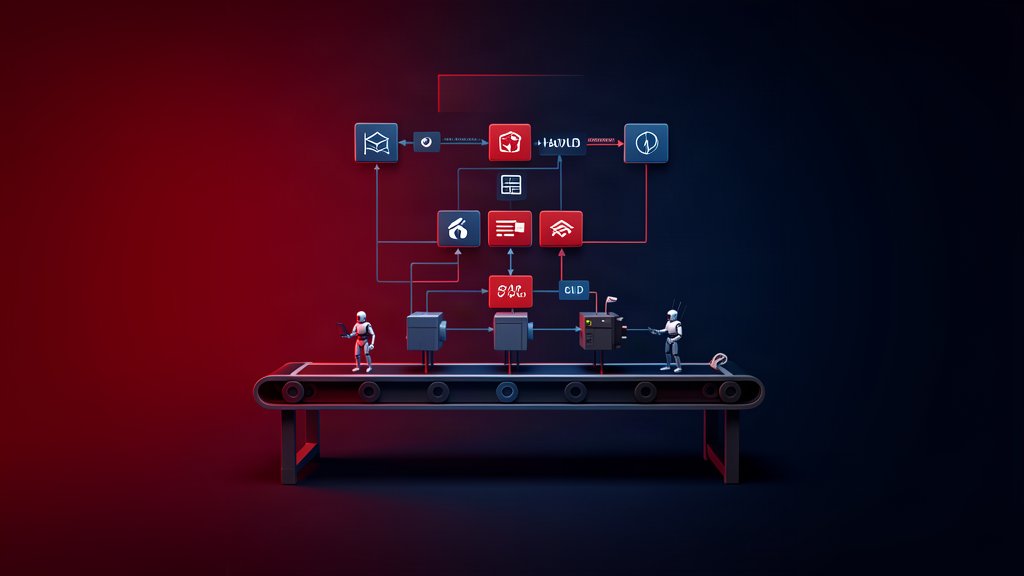
The problem is not that agents cannot produce useful output. It is that they have been shipping outside the normal release process — fast, informal, and without the quality gates, rollback paths, and observability that production software requires. Harness Agent DLC attempts to close that gap with five capabilities designed to fit into existing CI/CD pipelines.
AI Evals — Quality Gates for Non-Deterministic Systems
Standard continuous delivery assumes deterministic software: the same inputs produce the same outputs. An AI agent breaks that assumption. The same prompt with the same tools can produce different responses across runs, making traditional canary analysis meaningless. You cannot diff an agent’s behaviour the way you diff code.
AI Evals replaces output comparison with quality measurement. You define a dataset of representative inputs, configure scoring functions for correctness, safety, and performance — each normalized on a 0.0–1.0 scale — and set a pass threshold. Harness wires this into the pipeline as a stage, the same way a lint check or test suite runs. If the eval score drops below threshold after a model change or prompt update, the deploy stops.
This is the missing link between manual testing and silent production regressions. For teams already running evals in notebooks or ad-hoc scripts, having them as a pipeline gate changes the workflow from optional check to enforced standard.
Agent Deployments — Managed Runtimes with Canary Releases
Agent Deployments adds out-of-the-box pipeline steps for Amazon Bedrock AgentCore and Google Agent Runtime, the two most common managed agent hosting services. The deployment model includes canary releases — route a percentage of traffic to a new agent version before full rollout — and Open Policy Agent guardrails that enforce operational boundaries at deploy time.
For teams not using Harness, the pattern itself is worth adopting: treat an agent deployment as a staged rollout, not a file copy. The same approval gates and rollback procedures that protect microservice deployments should protect agent deployments, yet most teams skip them.
AI Configs — Decouple Model and Prompt Changes from Binary
AI Configs separates model selection and prompt content from the agent binary, backed by Harness’s existing feature flag infrastructure. You can swap the underlying model or adjust a prompt at runtime without a full redeploy. If a prompt change degrades quality, roll it back from the config layer rather than cutting a new release.
This mirrors what platform teams have done for years with feature flags and configuration management. Applying the same discipline to AI configuration means prompt changes become auditable, reversible, and separable from code deploys — something that is rarely true in current agent workflows.
Agent Security — From Bill of Materials to Continuous Firewall
Agent Security introduces automated vulnerability scanning specific to agent architectures. It generates a bill of materials for every agent — covering base models, plugins, skills, and dependencies — and runs adversarial input tests before deployment to probe for prompt injection, jailbreaking, and tool misuse vulnerabilities.
In production, a continuous firewall monitors agent inputs and outputs for policy violations. For regulated industries where agent decisions have compliance implications, this layer is essential. For everyone else, the bill of materials alone is a significant step forward. Most teams today cannot answer the question “what models and plugins does this agent depend on?” with any confidence.
AgentTrace — Decision-Path Observability for Debugging
AgentTrace records the full decision path for every agent run: which tools were called, the latency at each step, the prompts and model outputs at every turn. The practically useful feature is the ability to export production failures into eval cases with one click, closing the loop between what breaks in production and what gets tested in CI.
Harness is open-sourcing the foundational components — the harness-sdk and harness-evals libraries — under Apache 2.0. These work with any OpenTelemetry backend, meaning the observability standard itself is not locked to the Harness platform. If you use OTel today for your existing services, you can plug in AgentTrace components without migrating your observability stack.
What This Means for the Agent Delivery Pipeline
Agent DLC does not introduce concepts that are new to platform engineering. Eval gates, staged rollouts, config decoupling, security scanning, and decision-path tracing all have equivalents in conventional software delivery. What is new is applying them to AI agents as a unified pipeline concern rather than bolting them on after the fact.
The broader takeaway is structural. The reason most agent pilots do not reach production is not a failure of model intelligence — it is a failure of delivery discipline. Teams that treat agents as experimental scripts skip the infrastructure investments, governance processes, and ownership structures that would accompany a normal service release. Agent DLC gives teams a forcing function: when your agent goes through the same change record, quality gates, and approval chain as the rest of your software, it becomes harder to treat it as still experimental.
Getting Started
If your team is already on Harness, Agent DLC features are rolling out to customers now. For teams using other CI/CD platforms, the open-source harness-evals library provides the eval gate component independently, compatible with any OpenTelemetry backend. Start with observability — most production agent failures are detected by users before they are detected by dashboards, and AgentTrace addresses that gap directly.
For related context, see the earlier piece on why AI agents in DevOps are only as good as the platform beneath them, which argues that the same engineering fundamentals — tests, telemetry, rollback paths — determine whether AI automation helps or hurts, regardless of the tooling layer on top.
Related areas
Related What I Do
These What I Do pages are matched from the subject matter of this article, creating a cleaner path from educational content to implementation work.
Continue reading
Related articles
Based on shared categories first, then the strongest overlap in tags.