A retrieval system is easier to operate when the data model matches the way the product is actually used.
That is why Qdrant’s multitenancy and collection alias features matter. They are not just infrastructure details. They are the things that let a search or RAG system serve real users without becoming painful to change later.
The Multitenancy Idea
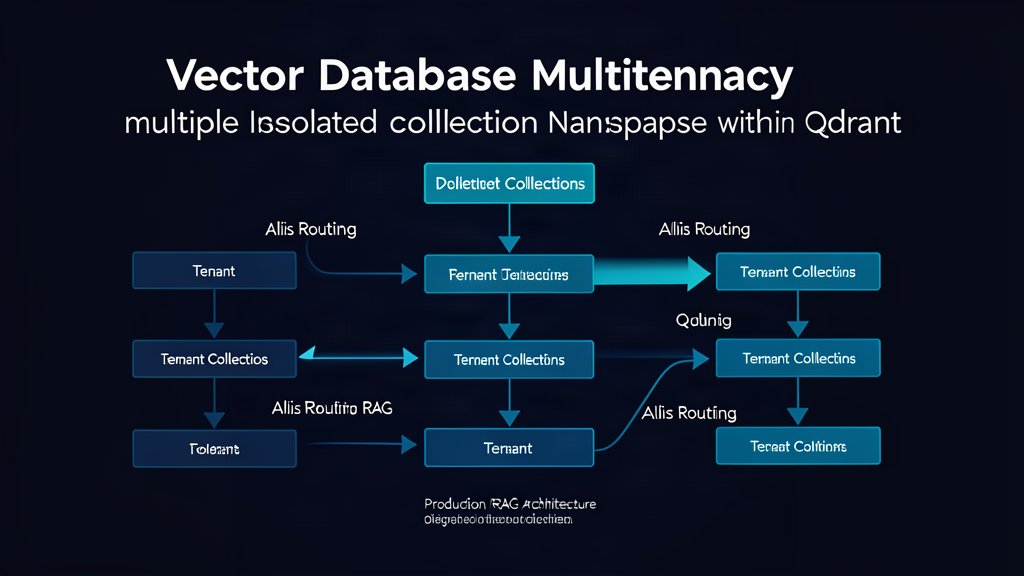
Qdrant’s documentation recommends, in many cases, using a single collection with payload-based partitioning for multitenancy.
That is a useful default because it keeps the system simpler than creating a separate collection for every tenant or customer.
The practical benefit is straightforward:
- Less collection sprawl.
- Easier operational management.
- Better room for shared tuning and index behavior.
- Cleaner retrieval logic when the application already knows which tenant it is serving.
If you only have a limited number of users and need isolation, multiple collections can still make sense. The key is to choose based on how much separation you really need, not on habit.
Why Collection Design Matters
A lot of RAG problems start as data problems.
If tenant boundaries are unclear, retrieval can cross over in ways that are hard to detect. If the collection strategy is too fragmented, maintenance becomes expensive. Qdrant gives you enough structure to model both of those cases.
Collections are the main unit of organization, and they can carry metadata, named vectors, and sparse vectors. That gives you room to keep the retrieval layer organized without flattening everything into one opaque blob.
Collection Aliases Are The Operational Safety Valve
Aliases are one of the most practical features in Qdrant.
They let you attach a stable name to a collection and switch that name from one underlying collection to another atomically. In practice, that means you can build a new collection in the background and move traffic over without breaking requests.
That is useful when:
- You are reindexing data.
- You are upgrading embeddings.
- You are changing chunking strategy.
- You want to test a new retrieval configuration safely.
Instead of forcing a risky cutover, you keep the public name stable and swap the implementation behind it.
Why This Matters For Production RAG
Production RAG systems change.
The source content changes, the embedding model changes, the retrieval logic changes, and the business wants those changes without downtime. Collection aliases make that possible in a cleaner way.
They also reduce the temptation to mutate a live retrieval setup too aggressively. That makes the system easier to reason about, which is exactly what you want when search quality and uptime both matter.
What To Remember
A good Qdrant deployment is not just about vectors.
It is about how you organize tenants, how you keep retrieval isolated, and how you switch versions safely when the system evolves.
That is why multitenancy and aliases are worth understanding early instead of treating them as advanced extras.
Bottom Line
Use Qdrant multitenancy when you want a practical way to partition retrieval for multiple users or customers.
Use collection aliases when you need safe, atomic switches between retrieval versions without disrupting production traffic.
Together, those features make Qdrant a much better fit for production RAG than a simple demo-only vector store.
Reference: Qdrant Collections and Qdrant Hybrid and Multi-Stage Queries.
Related areas
Related What I Do
These What I Do pages are matched from the subject matter of this article, creating a cleaner path from educational content to implementation work.
Continue reading
Related articles
Based on shared categories first, then the strongest overlap in tags.