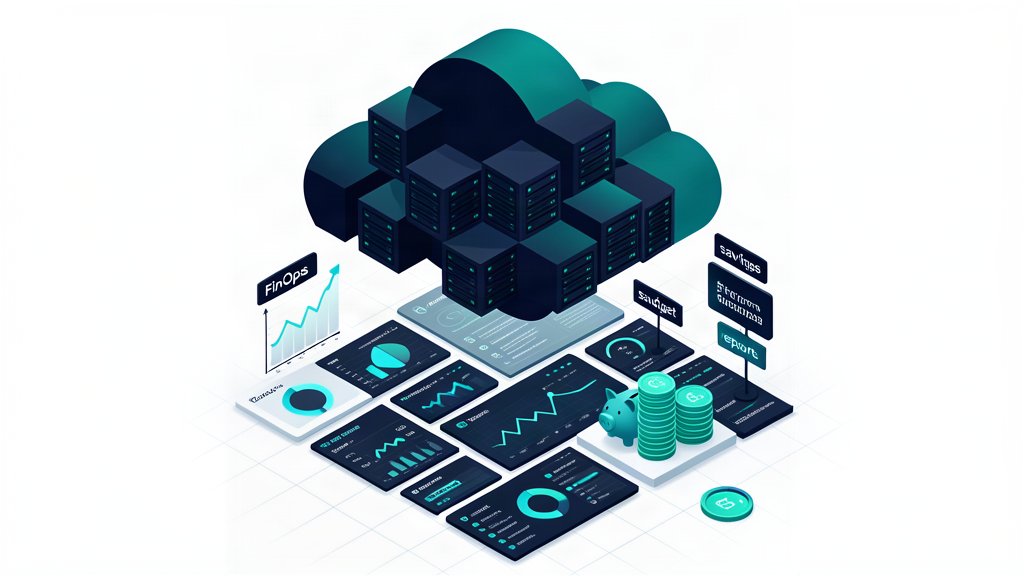

The monthly cloud bill is a post-mortem, not a control. It arrives weeks after the decision that caused it, attributes a large number to a vague shared-services bucket, and lands with someone who has no authority to change anything. The only action left at that point is regret.
Small platform teams get surprised by the same categories of spend over and over: a staging cluster that ran through the weekend, a load balancer nobody deleted, a data-transfer spike between two regions, a test job that pulled a terabyte. My position is direct. A small team controls cloud waste far more reliably with explicit cost ownership, budget thresholds, and actionable alerts than with retrospective reporting alone. A report tells you what happened last month; a guardrail changes what happens next.
Four guardrails carry most of the weight, and none of them needs a dedicated FinOps hire: allocation, thresholds, creation-time controls, and a response path with named owners. The rest of this article is about standing each one up without building a governance program around it.
Make every resource answer to a name
Allocation is the foundation, and provider structure is the cheapest allocation key you already own. A separate AWS account, Azure subscription, or Google Cloud project per environment separates production spend from staging spend before anyone writes a tag. The FinOps Foundation allocation guidance treats that structural separation as the starting point and layers metadata on top of it.
Three labels carry most of the remaining value: owner, environment, and service. A resource that has all three can be routed to a person, grouped into a cost report, and compared against a budget. A resource that has none stays invisible until the invoice arrives. The headline metric is not total spend but the unallocated share — the percentage of the bill you cannot attribute to a team. Treating that number as a first-class KPI turns tagging from housekeeping into a measurable goal. The same guidance accepts a deliberate “informed ignore” for genuinely shared costs such as a central logging stack; the point is to make that decision consciously rather than leave it unattributed by accident.
Enforce the labels where the resource is created. A Terraform module that requires an owner variable, or a CI policy that rejects a plan containing an untagged resource, produces tags that survive. A wiki page asking engineers to tag things does not. The cheapest enforcement point is the same pull request that introduces the resource, and it costs one review comment to add.
Budgets and alerts turn drift into a signal
Provider-native budgets are the second guardrail, and they are already included in every major cloud. AWS Budgets, Azure Cost Management budgets, and Google Cloud billing budgets all support thresholds against both actual and forecasted spend, which means you can learn in the middle of the month that the current trajectory is heading somewhere you do not want. Each service documents its own alert behavior: see AWS Budgets actions, the Azure budget tutorial, and Google Cloud budgets.
Anomaly detection adds a different signal. Instead of comparing spend to a static threshold, it compares today to a learned baseline and flags the deviation. AWS Cost Anomaly Detection runs machine-learning evaluation roughly three times a day with up to 24 hours of detection lag, and it supports alert subscriptions with absolute or percentage thresholds (AWS documentation). Azure evaluates costs daily against data that can be 8 to 24 hours old. Set expectations accordingly: this is not real-time telemetry. An anomaly alert is a “look at this in the morning” signal, not a pager.
The distinction that teams most often get wrong is that a budget informs; it does not stop spending. Microsoft states plainly that budget alerts leave resources unaffected and do not stop consumption. Google Cloud states that setting a budget does not automatically cap usage or spending. The default across all three providers is notification.
Automatic enforcement exists, and it is a deliberate escalation rather than a default. AWS Budgets actions can apply an IAM policy or an SCP deny policy when a threshold is crossed, either automatically or after manual approval. Azure action groups can trigger a runbook that stops virtual machines, and Microsoft documents exactly that pattern in its budget scenario walkthrough. Google Cloud can publish a Pub/Sub message that a function uses to disable billing on a project. Every one of those options carries outage risk: a shutdown that fires on bad or delayed data takes production down. Start with notification, keep the manual approval step, and automate only the cases where the blast radius is understood.
Budgets also drift out of date. A threshold set at launch is wrong six months later, once the workload or the price list has moved. A short scheduled review — thirty minutes a month, looking at unallocated spend, threshold breaches, and open exceptions — keeps the numbers honest and gives the guardrails an owner in the calendar.
Control spend at the point of creation
Alerts describe what already happened. Controls decide what can happen at all, which is why provider structure matters twice over. Separate accounts, subscriptions, or projects per environment stop a lost experiment in one place from consuming the budget of another. Google Cloud’s Cloud Billing Budget API recommends one budget per project precisely so that per-project overspend surfaces against the project that caused it.
For self-service infrastructure, quotas and policy set the ceiling before a request is fulfilled. A team that can provision a database in a pull request should also hit a maximum instance class, a maximum storage size, and a maximum count, all defined in code. The control belongs next to the template that creates the resource, in the same review.
Kubernetes deserves specific attention because a shared cluster is a shared bill. Two native objects do most of the cost work. ResourceQuota caps the aggregate CPU, memory, storage, and object count that a namespace can consume. LimitRange injects default requests and limits and enforces minimum and maximum values, so a container that forgets to declare a limit cannot quietly consume a shared node. Neither object is a billing tool on its own, and both are effective cost guardrails because they make the ceiling explicit at admission time. A team that would rather shrink the cluster than govern a large one should read the earlier piece on lightweight Kubernetes for small teams, where cluster size itself works as the control, and the wider platform-team context behind those choices in Kubernetes and platform engineering in 2026.
Every alert needs an owner and an expiry
An alert routed to a shared inbox is not an alert; it is a notification nobody owns. The FinOps Foundation’s anomaly management guidance is unambiguous that detection is only the first step, and that the value comes from routing the finding to the responsible team, investigating the cause, and documenting the resolution. That guidance is written for large organisations, and the principle scales down without any of the ceremony.
Give every budget and every anomaly scope a named investigator — one person, not a team alias. The response can stay lightweight:
- Acknowledge the alert within one working day.
- Investigate the root cause by service and label, using the allocation you already have.
- Resolve it, or accept it with a written exception that has an owner and an end date.
The third step is where most teams leak money. “We know the staging environment is expensive during this migration” is a decision with a lifespan. “Staging is expensive” with no end date is a permanent increase to the baseline that nobody re-examines. Record the exception, name the owner, and set the expiry. At the end of that period the exception gets renewed deliberately or the spend gets fixed. The FinOps budgeting guidance makes the same point about handling out-of-cycle budget changes through an explicit process instead of a silent adjustment.
What these guardrails are not
None of this requires a FinOps team, a chargeback program, or a commercial cost-management platform. That is the point. A team of five can run four guardrails with the tooling already attached to its cloud accounts.
The trade-offs are real, and it is dishonest to pretend otherwise. Label enforcement adds friction to every new module, and that friction is the first thing dropped under deadline pressure. Forecast alerts fire early and noisily on services with spiky traffic. Anomaly detection on a small, low-variance account produces false positives that train people to ignore the channel. Thresholds rot. Every guardrail has a maintenance cost, and the right number of guardrails is the number the team will still maintain through a busy quarter.
A week-one stack
Start with the smallest version that creates accountability:
- Define owner, environment, and service labels, and enforce them in the provisioning path.
- Separate environments by account, subscription, or project.
- Create one budget per meaningful scope with an actual threshold and a forecast threshold, routed to a named person.
- Enable the provider’s anomaly detection for the accounts that carry real spend.
- Put a thirty-minute spend review on the calendar once a month.
- Keep a short exception register with owners and expiry dates.
That stack will not produce a perfect cost graph in the first month. It will produce something more useful: a bill that arrives with the names already attached to it, and alerts that somebody is expected to act on. The optimization work — right-sizing, commitments, storage lifecycle, egress reduction — lands after the guardrails exist, because optimization only holds when ownership and thresholds keep it honest. The practical side of that work is covered in Cloud Cost Optimization in 2026, which pairs naturally with the governance layer described here.
Cloud waste on a small team is rarely a technical mystery. It is a missing name, a missing threshold, and a missing owner. Fix those three things, and the monthly report stops being a post-mortem.
Related areas
Related What I Do
These What I Do pages are matched from the subject matter of this article, creating a cleaner path from educational content to implementation work.
Continue reading
Related articles
Based on shared categories first, then the strongest overlap in tags.