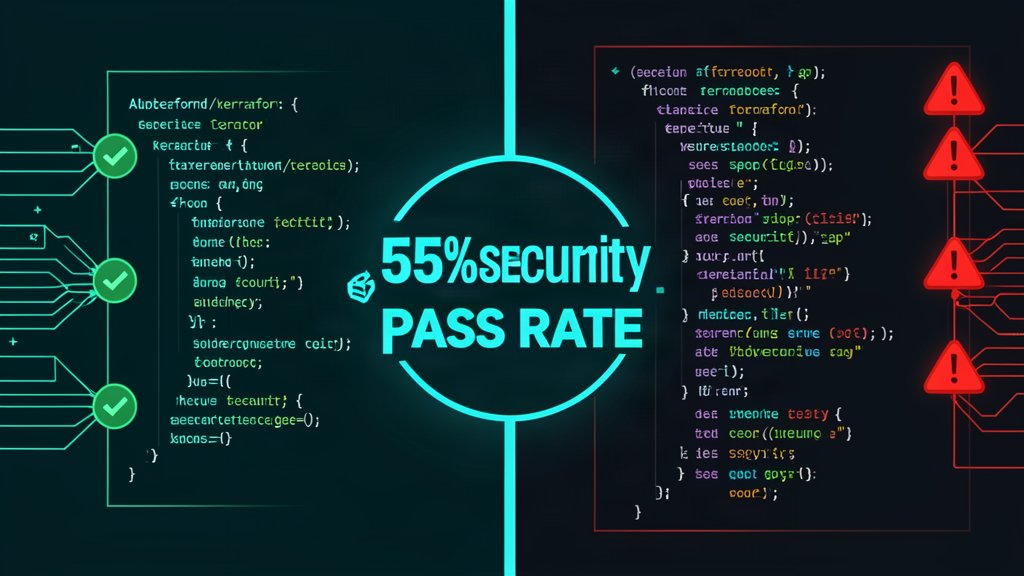
AI agents now write a growing share of Terraform, Kubernetes, and cloud configuration code in production. The syntax is correct more than 95% of the time. The security pass rate has been stuck at roughly 55% for two consecutive years. That gap — between “it compiles” and “it’s safe to run” — is the defining infrastructure-as-code risk of 2026.
The Veracode Spring 2026 GenAI Code Security Update evaluated 80 coding tasks across 4 languages, 4 Common Weakness Enumeration (CWE) vulnerability classes, and more than 150 LLMs. The headline finding is stark: only 55% of AI code-generation tasks produce secure code out of the box. Syntax correctness has surpassed 95%, but security has flatlined. Models have become excellent at writing code that compiles; they have failed at writing code that is safe.
AI Is Accelerating IaC Output
The volume problem compounds the quality problem. In env0’s 2026 survey, 71% of cloud teams report a measurable increase in infrastructure-as-code volume driven by generative AI. AI agents generate pull requests faster than most teams can review them, creating a new kind of bottleneck across engineering organizations.
Teams face two bad options: slow everything down by insisting on manual review of every change, or accept unreviewed risk in production. Infrastructure vulnerabilities compound this tradeoff in a way application-code vulnerabilities do not. An open security group or misconfigured IAM role exposes entire environments, not single services. According to the IBM/Ponemon 2025 Cost of a Data Breach report, breaches spanning multiple environments cost an average of $5.05 million and take 276 days to contain.
For more on how the review bottleneck affects IaC workflows, see the earlier post on how Terraform keeps small infrastructure changes reviewable.
What the Veracode Data Actually Shows
The Veracode evaluation tested 150+ LLMs across 80 coding tasks, targeting four CWE vulnerability types in Python, C#, JavaScript, and Java. The results reveal where models succeed, where they fail consistently, and where reasoning helps.
By vulnerability type:
| Vulnerability | Secure rate | Assessment |
|---|---|---|
| Insecure Cryptography (CWE-327) | 86% | Strong — well-documented patterns |
| SQL Injection (CWE-89) | 82% | Strong — clear specification |
| Cross-Site Scripting (CWE-80) | 15% | Persistent failure |
| Log Injection (CWE-117) | 13% | Worst category, directly relevant to observability configs |
SQL injection and cryptographic misuses follow well-documented patterns that models handle well. Cross-site scripting and log injection are persistent failures. Log injection is especially relevant to infrastructure code, where observability pipelines generate structured logs that can be exploited through unsanitised input.
By language:
| Language | Secure rate |
|---|---|
| Python | 62% |
| C# | 58% |
| JavaScript | 57% |
| Java | 29% |
Java ranks worst by a wide margin. The most likely explanation is that Java training data contains a disproportionate share of legacy enterprise code built on insecure frameworks, teaching the models patterns that should not be reproduced.
By model tier:
Top models — GPT-5.1, GPT-5.2, Gemini 3, Claude 4.5, Claude 4.6 — all cluster at roughly 55%, with no meaningful differentiation. Model size stopped being a differentiator: even 400-billion-parameter models land at the same 55% ceiling. Reasoning models (GPT-5 extended reasoning) reach 70–72%, which is better but still represents a 28–30% failure rate on security-critical tasks.
The pattern is clear: models have converged on a security ceiling that no amount of scale or architectural iteration has moved in two years. The gap is not a race to larger models — it is a governance problem.
Why This Is a Platform Engineering Problem
Application-code vulnerabilities affect one service. Infrastructure-code vulnerabilities — IAM policies, security group rules, network ACLs, container security contexts — expose entire environments. A single misconfigured Terraform resource can bypass every application-layer security control.
Gartner projects that 80% of large software engineering organisations will have platform engineering teams by 2026, up from 45% in 2022. Platform teams define the “paved road” — the templates, modules, and guardrails that make correct infrastructure the default path. That mandate now extends to AI agents as first-class platform consumers.
The DORA 2023 State of DevOps report found that teams with frequent configuration drift had 2.3 times higher change failure rates. AI-generated infrastructure changes applied outside review cycles directly accelerate drift. With every change that passes through a defined pipeline with automated checks, drift is caught early. But when AI agents bypass that pipeline, each unchecked change becomes a potential production incident.
For broader context on why platform maturity determines whether agentic workflows help or hurt, see the analysis of Kubernetes and platform engineering in 2026.
Practical Guardrails — What Governance Looks Like in 2026
Four capabilities distinguish mature platform teams that treat AI agents as governed infrastructure consumers rather than exceptional cases.
1. Policy as code enforced before generation, not after
Pre-plan policy validation — using tools like Sentinel or OPA style policies at the planning stage — reduces policy violation build failures by up to 45%, according to DevOps.com reporting on StackGen’s data. The key architectural decision is that constraints belong upstream of generation, not downstream. Scanning generated configs after the fact is better than nothing, but it catches violations that have already consumed developer time and compute resources.
2. RBAC that treats agents as first-class actors
Every AI agent operating against infrastructure needs scoped permissions, resource quotas, and audit logging — the same controls you would apply to a new hire with production access. Many developers do not adjust default permission scopes in AI-generated code, so the blast radius of a vulnerable Terraform plan depends directly on what the agent’s credentials can reach.
3. Continuous drift detection with automated correction
Self-correcting infrastructure that reverses unauthorised changes and reconciles state is no longer aspirational. The practical threshold is automatic remediation for known-good patterns and human escalation for exceptions that require judgment. Manual alerting alone produces alert fatigue and eventual blindness.
4. Compliance validation built into the generation step
The most advanced pattern validates intent against policy at generation time rather than post-scan. Code that is compliant by construction, not by correction, eliminates the cycle of generate-scan-fix-regenerate that characterises most current AI-assisted IaC workflows.
Five Questions for Your Team
Adapted from the DevOps.com guide on governing AI-generated infrastructure:
-
Can AI agents deploy to production? They should not have broad access. Agent credentials must be scoped, reviewed, and rotated like any production credential.
-
Is policy checked before or after generation? After-generation scanning wastes cycles and misses violations that pre-plan validation catches.
-
Who reviews AI-generated IaC, and at what ratio? Establish a clear threshold for how many AI-generated PRs one reviewer can safely evaluate per day.
-
Is drift detected and corrected automatically or just alerted? Manual alerts produce eventual blindness. Automated correction handles the common cases.
-
What is the business cost of ungoverned AI-generated infrastructure? The $5.05 million average multi-environment breach cost from the IBM/Ponemon study provides a starting point for your risk assessment.
The Productivity/Security Tradeoff
AI’s IaC productivity gains are real. The syntax correctness numbers prove that models can generate working infrastructure configurations reliably. But without deliberate governance, those productivity gains come packaged with compounding security debt.
The gap between “code that works” and “code that works securely” is not just persisting — it is widening as more teams adopt AI-assisted IaC pipelines without corresponding governance investment. That gap will drive the next wave of cloud incidents.
Platform teams that extend policy-as-code, RBAC, and continuous compliance to AI agents now — rather than treating agent-generated infrastructure as a special case — will capture the productivity gains without inheriting the security debt. The productivity revolution is here. The security revolution is not. That gap defines the challenge ahead.
Related areas
Related What I Do
These What I Do pages are matched from the subject matter of this article, creating a cleaner path from educational content to implementation work.
Continue reading
Related articles
Based on shared categories first, then the strongest overlap in tags.